Tractor Weight Resources & Knowledge Center
Listed below is information, articles, and links we routinely provide to our customers regarding tractor weights, ballasting, and installation procedures. You can peruse the list at your leisure or contact us if you need more immediate assistance.
TractorWeights.com Resources
Practical information for tractor weights, ballast, fitment, tires, and installation.
Use these guides to understand the measurements, terminology, hardware, and operating considerations that can affect a tractor-weight purchase or installation. For product-specific questions, always verify the fitment information on the product page before ordering.
Tractor Weight & Ballast Glossary
Clear definitions for wheel weights, suitcase weights, starter weights, chord length, bolt circle diameter, mounting patterns, stacking hardware, ballast, fitment, and other terms used throughout TractorWeights.com.
Fitment & Measurement
Use these resources to identify a wheel-weight mounting pattern, understand the measurements involved, and learn what “conditional fitment” means before ordering.
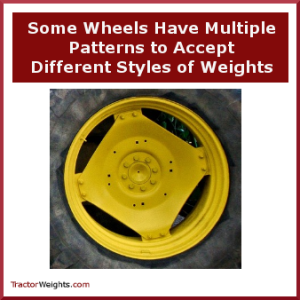
Wheel Weight Mounting Patterns
Learn how hole count, chord length, bolt-circle diameter, wheel style, clearance, and mounting hardware work together when identifying a wheel-weight pattern.
Chordal Length Calculation Chart
Use this chart when bolt-circle or pitch-circle diameter is known and you need the straight-line chord measurement between mounting holes.
Inch Fraction to Decimal Chart
Quickly convert inch fractions to decimals and metric equivalents when measuring wheel holes, bolt sizes, clearance, or mounting dimensions.
Conditional Fitment
Some products may fit only after a required measurement, mounting-pattern check, clearance review, or hardware confirmation.
Product Help & Fitment Support
Use product-specific fitment information first. Contact support when you need help confirming your equipment, dimensions, hardware, or application.
Tractor Weight & Ballast Glossary
Look up terms such as starter weight, wheel center, mounting face, required measurement, ballast, and bolt circle diameter.
Ballast & Loader Work
Ballast needs vary by tractor, attachment, tire type, terrain, and the work being performed. These resources explain the tradeoffs before you add weight.
Ballasting Loader-Equipped Tractors
Learn why loader work changes rear-ballast needs and what to consider when using buckets, grapples, forks, and other front-loader attachments.
Fluid Ballast Versus Iron Weights
Compare liquid ballast and cast-iron weights, including considerations for radial tires, bias-ply tires, ride quality, flexibility, and application.

Liquid Ballast Fill Chart
View estimated tire-fill volumes and weights by tire size for beet juice, calcium chloride, water, and anti-freeze. Review all assumptions and notes before use.
Tractor Weight: When More Is Not Better
Read practical discussion about ballast value, excess weight, and why tractor setup should match the work instead of following a one-size-fits-all rule.
Carrying the Load
Understand tire construction and load-related considerations, including IF and VF tire terminology used on modern equipment.
Ballast Terms Explained
Need a quick definition of counterweight, front-to-rear balance, wheel weight, suitcase weight, fluid ballast, or starter weight?
Tires & Capacity
Tires carry the added load created by ballast. Review tire construction, load ratings, speed ratings, and tread type before changing your tractor setup.
Tractor Tire Codes Made Simple
A practical guide to reading tractor tire codes, including tire size, bias-ply information, ply rating, load rating, speed rating, and wheel diameter.

Tire Speed & Load Index Chart
Use this reference when checking the speed and load index marked on your tires. Confirm actual tire capability with the tire manufacturer and tractor documentation.
Common Tractor Tire Tread Types
Review common agricultural tread designations such as R1, R2, R3, and R4 and understand why tire choice matters for traction and surface conditions.
Radial, Bias-Ply, IF & VF Terms
Use the glossary for concise definitions, then continue to the tire and ballast guides for application-specific discussion.
Hardware & Installation
Mounting hardware, torque, fitment, wheel clearance, and installation method can all affect safety and performance. Use these as general background resources—not as a substitute for product-specific guidance.
General Hardware & Torque Specifications
General advisory information for common wheel-weight mounting hardware, including bolt sizes, grades, and torque-related concepts.
Torque Wrench Conversions
Convert between foot-pounds, inch-pounds, and Newton-meters when working with torque values from manuals, hardware references, or product instructions.
Mounting-Pattern and Hardware Terms
Look up carriage bolt, clamp force, preload, torque specification, mounting face, hole count, and bolt-circle diameter.
Need Installation Help?
For a particular TractorWeights.com product, use the product page’s fitment information and contact support before ordering when measurements or hardware are uncertain.
More TractorWeights.com Resources
Explore the blog for detailed articles, review where our products are made, or contact us when you need help with a TractorWeights.com product or fitment question.
Important: These resources provide general background information. Product listings, verified compatibility information, manufacturer instructions, tire ratings, and your equipment owner’s manual should guide final fitment, installation, and operating decisions.
Tractor Weight Resources. The Tractor Weight Store™