What do AI Overviews, Chatbots, and AI Agents have to do with buying tractor weights?
More than you think—and if you aren’t careful, relying on an algorithm could cost you hundreds of dollars and loads of frustration.
Artificial Intelligence is permanently changing how we find information. Today, anyone can ask a search engine a question and instantly receive an answer that sounds remarkably confident. But in our highly specialized niche of the tractor weight industry, we are discovering that AI’s version of the truth is often completely unhinged.
Here is why AI is failing tractor owners, and how we are adapting at tractorweights.com to ensure you get the right parts the first time.
The Illusion of “Will Fit”
Imagine asking your favorite AI tool to find rear wheel weights for your Kubota M7040. Almost instantly, the AI will pull up both OEM branded and aftermarket options and confidently guarantee that they “will fit.”
Unfortunately, AI doesn’t work in a real-world shop. It doesn’t know the mechanical nuances that human experts track daily:
- Aftermarket Wheels Vary: A massive industry exists making aftermarket tractor wheels with weight mounting holes that differ entirely from OEM specifications. Only you know for sure what is installed on your tractor.
- Wheel Sizes Dictate Weights: Different wheel diameters (available options on the same model tractor) often require entirely different physical weight dimensions and offsets.
- Supply Chain Chaos: Recent shortages have forced some major tractor brands to swap out standard wheels mid-production. If a model’s assembly line or supplier suddenly shifted to a different factory or country, it might roll onto the dealer lot with entirely different wheels than previous production years.
- Smaller Tractor Brands: Sudden wheel changes are common, even in mid cycle production. Many lower-volume brands frequently shop around mid-cycle to capitalize on better component pricing or bulk freight deals from competing industrial rim manufacturers.
Branded tractor dealers often contact us directly to solve these exact fitment puzzles. If the manufacturers and dealers themselves are struggling to track these sudden assembly changes, an automated AI agent scraping the web certainly isn’t going to catch them.
How We Are Thriving in an AI World: “Conditional Fit”
We refuse to let our customers rely on poorly trained AI bots. To adapt and protect your bottom line, we are beginning to introduce Conditional Fit notations across the tractorweights.com catalog.
A “Conditional Fit” label shouldn’t scare or worry you. It simply means we have done the homework the AI can’t do or didn’t do. When you see this label, we provide the exact real-world dimensions you need to check so you never make an ordering mistake. Over time, we hope the search algorithms learn from our data that a model number alone is never enough to determine fitment.
Going forward, our product compatibility charts will clearly outline your verification steps. Here is how these listings will appear on our website:
| Make | Model | Series | Fitment Status | Verify Before Ordering |
|---|---|---|---|---|
| Kubota | M7040 | M Series | Conditional Fit | Wheel weight mounting pattern, wheel diameter, valve stem clearance |
Before you click buy, these “Conditional Fit” notes will remind you to check the obvious, critical details: your specific wheel weight mounting pattern, wheel size, outer diameter clearance, valve stem clearance, and tire overhang when stacking multiple weights.
Real Example: When AI is “Not Even Wrong”
Most of our tractor weights are dimensionally identical to the more expensive OEM branded weights sold at your local dealership. But because the internet is flooded with conflicting data, today’s AI search modes pull misleading information, blend it together, and present it as absolute fact.
To prove this point, on June 4, 2026, we asked a popular AI search assistant a straightforward question:
“What is the wheel weight mounting pattern on a Kubota M7040?”
The AI confidently instructed us to measure the Bolt Circle Diameter (BCD) by running a tape measure straight across the center of the wheel axle between opposite holes. It concluded that the measurement would land exactly on “9 ½ inches, 11 inches, or 11 ½ inches.”
To paraphrase a famous physicist: That is not only not right; it is not even wrong.
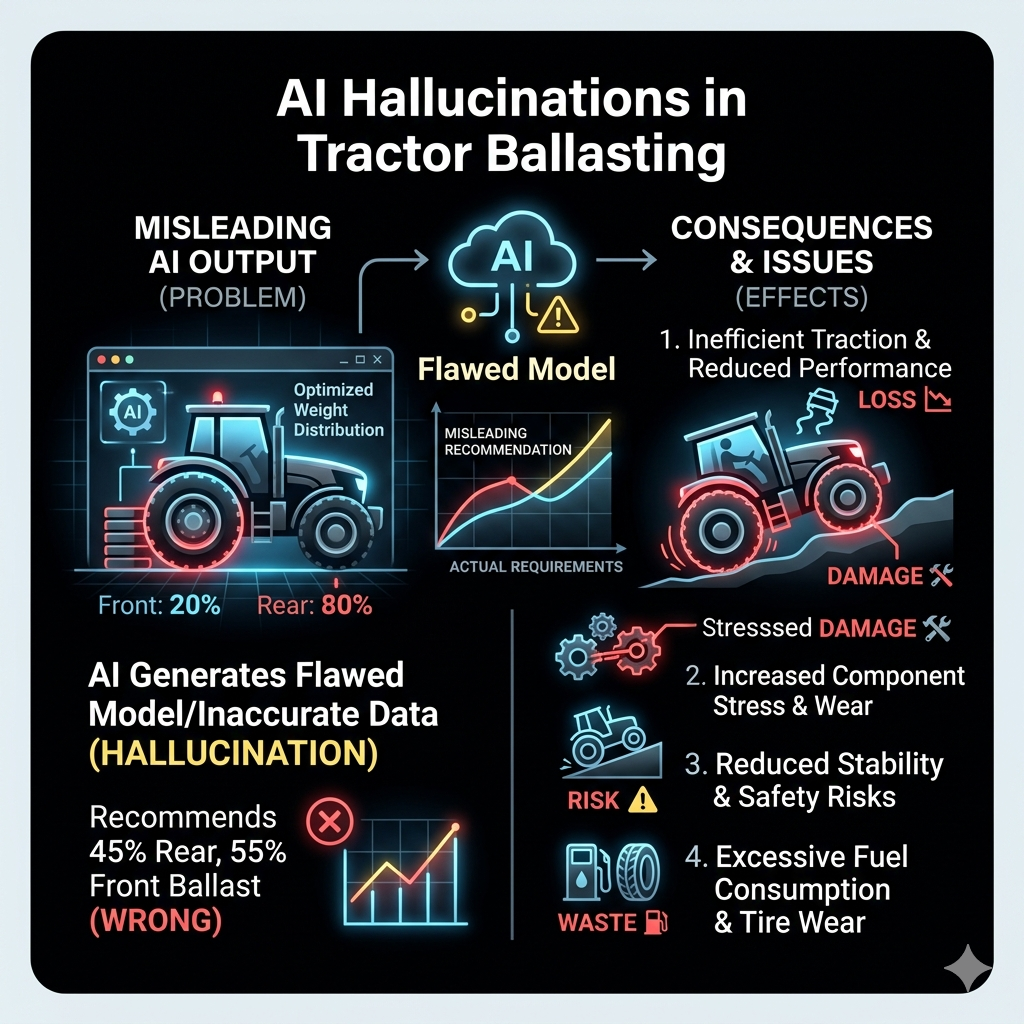
Tractor wheel weight mounting patterns are standardly calculated using chordal length measurements, not bolt circle diameters. The chordal system is the definitive industry standard. AI completely missed the baseline engineering physics of the part. See How It Really Works.
Human Expertise Trumps the Algorithm
AI isn’t inherently malicious; it is just a mirror of the unverified data scattered across the internet. When it encounters conflicting forum posts, incorrect product offerings, or outdated spec sheets, it guesses.
At tractorweights.com, we are overriding the guesswork. We are attempting to build the most accurate, verified fitment database in the industry. In this new digital landscape, our corporate philosophy has to be “trust, but verify.”
Don’t gamble your time and money on a chatbot’s best guess. Use our tools, verify your real-world dimensions, and rely on human expertise to keep your tractor balanced and moving forward.
Remember that you can always Contact Us with questions about product selection and fitment. Further, our “check out” page has the option for you to ensure product fitment by entering notes about your tractor model or application. We always completely review those notes before capturing your payment or shipping your order. If we have a question or concern, we will get in touch with you.
This blog is general information only, representing the opinions of the author, and does not cover all aspects of the subject matter. Use of the information contained herein is voluntary.